
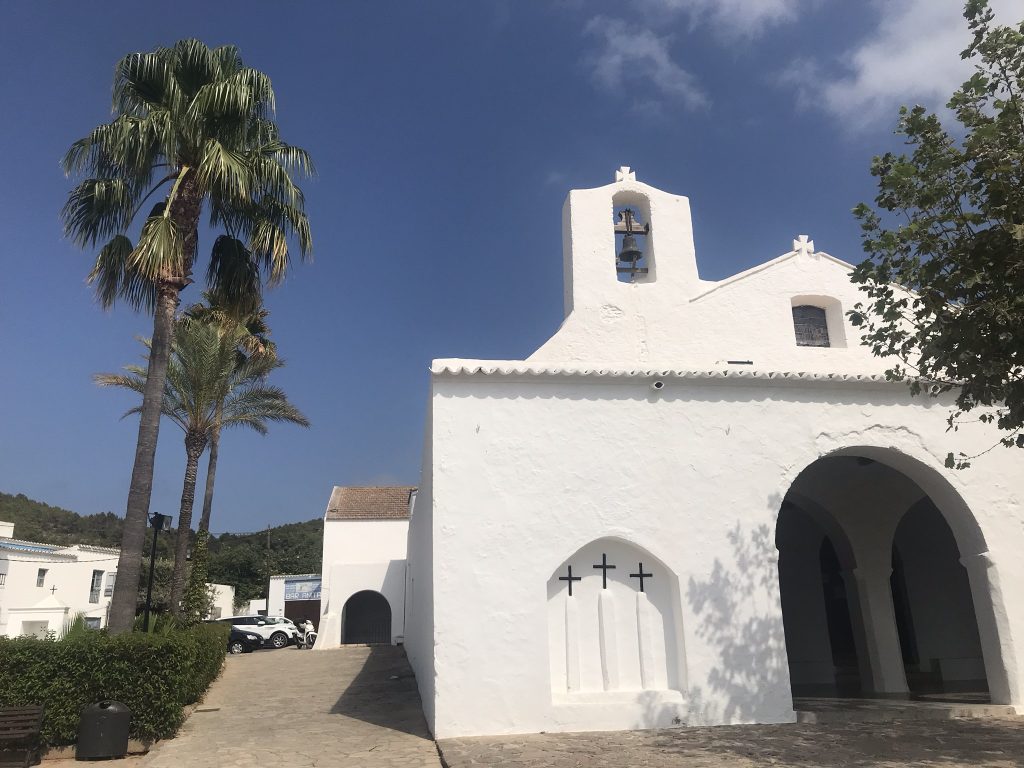
San Carlos, officially Sant Carles de Peralta, is one of Ibiza’s smallest villages but one of its best known, mostly thanks to Las Dalias, the hippy market that has been drawing visitors here for decades. Pair a market morning with a short drive to the coast and you have a relaxed half day that mixes crafts, village life and a swim.
A little history
San Carlos grew up around its whitewashed church, built in 1785, and stayed a quiet farming parish for most of its history, known for the carob and almond fields around it and, before that, for the Carthaginian-era lead mines a little further south. That changed in the 1960s, when the first hippy communities arrived and settled in and around the village, drawn by cheap rent and the remoteness, turning San Carlos into one of the island’s earliest countercultural hubs. Bar Anita became their unofficial headquarters from the start, and Las Dalias itself dates back even further: it opened on 4 November 1954 as a simple roadside bar and dance floor, built by a local farmer and carpenter named Joan Mari for that year’s Sant Carlos patron saint festival. It grew alongside the village through the decades, adding a restaurant in the 1960s and hosting Wednesday night jam sessions with visiting musicians through the 1970s, and only became the market people know today in 1985, when Joan’s son Juanito added the stalls that grew into the market you’ll find now.
Getting there and parking
San Carlos sits inland on the island’s east side, a short drive from Santa Eulalia and about 25 minutes from Ibiza Town. Las Dalias has its own car park just off the main road, but it fills fast on market Saturdays, especially in July and August. If it’s full, there’s further parking along the road itself: just keep clear of driveways and the carriageway.
Las Dalias hippy market
Las Dalias is Ibiza’s longest-running hippy market, with more than 300 stalls of handmade jewellery, clothing, leather and craft work spread across a shaded courtyard. It runs every Saturday, with hours shifting by season: roughly 10am to 8pm in June and September, 10am to 10pm through July and August, and shorter hours from October. Between June and September there’s also a separate night market on Sunday, Monday and Tuesday evenings, with live music and a different, more nightlife-leaning set of stalls. Go early if you want to browse without crowds, or later in the afternoon once the midday heat and the day-trip buses have thinned out.
Cala Mastella and El Bigotes
A ten minute drive brings you to Cala Mastella, a tiny pine-backed cove with clear water and barely a beach to speak of, just rocks and a narrow strip of sand. Its main draw is El Bigotes, a rustic beach shack with no menu and no card machine: you sit down, and whatever’s been caught that day, usually a garlicky fish and tomato stew, is what you eat. There are only a handful of tables, so arrive early, and bring cash since that’s all they take.
In the village itself
San Carlos’ own centre is small: a whitewashed church, a quiet square, and not much more, which is part of its appeal. Bar Anita, just off the square, has been a fixture of the village’s bohemian history since the hippy era and is worth a coffee or a beer even outside market hours. It’s a good place to end the visit before heading back toward the coast or on to Santa Eulalia.