
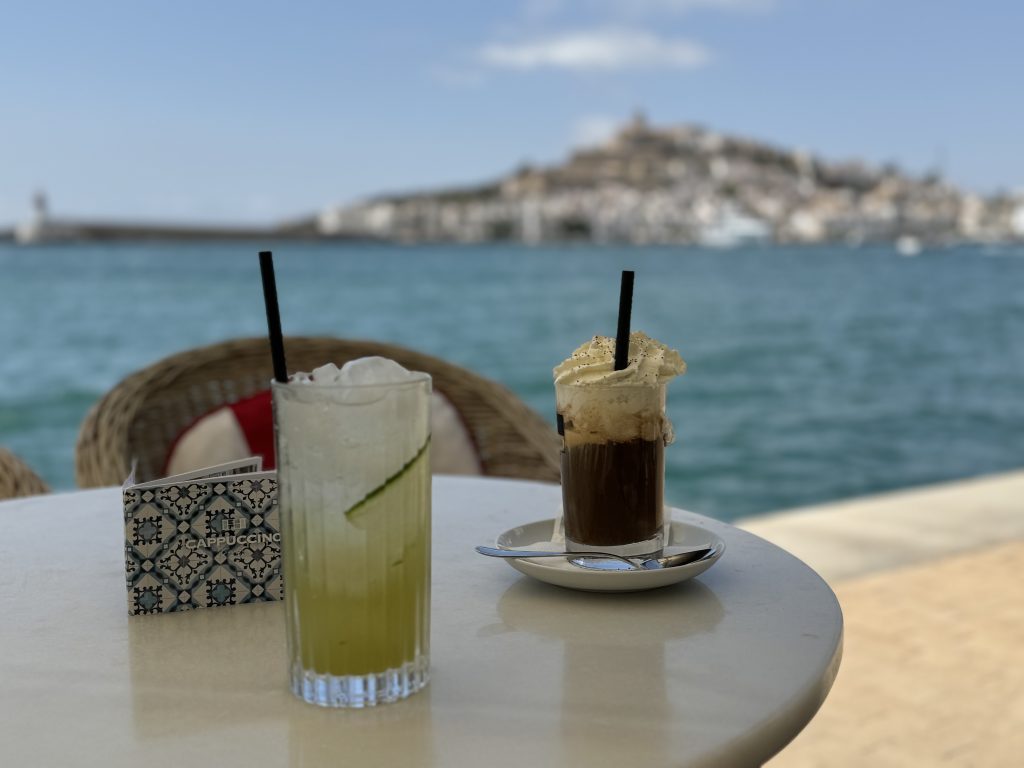
Marina Botafoch and Ibiza Town’s old walled quarter, Dalt Vila, sit on opposite sides of the same harbour, close enough to combine into one relaxed outing on foot. This route starts with breakfast (or brunch, or just coffee) on Marina Botafoch, takes in the yachts and boutiques of Botafoch, then follows the water round into town and up into Dalt Vila itself, a walk that carries you from superyachts to 2,700 years of history in a single morning.
Getting there and parking
If you’re driving, Marina Botafoch has on-street parking right along its own frontage, but most of it is metered blue-zone: marked bays, pay by meter or the elParking app, usually a couple of euros an hour. The giveaway for free parking anywhere in Ibiza (and Spain generally) is simple: no blue or green paint on the curb means no charge. Circle the streets just back from the marina front for a minute or two before settling for a paid bay: unmarked kerbs there are free and often only a couple of minutes further to walk.
If the marina itself is full, there’s also a large free open-air lot by the Botafoc Port ferry terminal, a short walk from the boutiques and restaurants.
As you come into the marina, you’ll pass a strip of designer boutiques mixed in with Ibiza-style fashion and swimwear shops, and Lío right on the water: a restaurant with a nightly cabaret show that turns into a club after midnight. Neither needs a stop this early in the day, but they’re worth clocking now if you’re weighing up an evening back here later.
Breakfast, brunch or afternoon coffee at the marina
Cappuccino Grand Café sits right on the marina promenade and is the obvious stop, and it doesn’t have to be an early breakfast: it works just as well as a full brunch a little later, or simply coffee and cake if you’d rather set off in the afternoon instead. Fresh juices, pastries, and a breakfast/brunch menu are served from around 8:30am well into the day. It’s a classic see-and-be-seen terrace, more about the view of the boats and Dalt Vila across the water than the food, so go in with that expectation rather than for a quiet, cheap meal (figure on €30+ a head). Go early if you want a table without a wait, or if it’s full, Calma a little further along the promenade is a good fallback with the same marina view and a calmer, less see-and-be-seen terrace.
Into town
From Botafoch it’s a genuinely walkable 10–15 minutes along the harbourside promenade round to Ibiza Town and the port beneath Dalt Vila’s walls, flat and pleasant the whole way, with the old town’s fortifications visible ahead of you for most of it. If you’d rather not walk it (or you’re driving and want to switch parking grounds instead of leaving the car at Botafoch), a small passenger ferry also runs the loop between the marinas and the old town port for a couple of euros, a nice way to arrive if the heat’s already up.
If you drove and want the car closer to Dalt Vila, there are paid garages near the port (Es Pratet is the main one) plus a few free, unmarked-street options a 10–20 minute walk out (Es Gorg, behind the Ikea, and Sa Joveria are the two most commonly used), so it’s worth deciding at Botafoch whether you’re walking the whole route or re-parking on the town side.
On foot or by car, most routes into the old town funnel through Passeig de Vara de Rey, Ibiza Town’s grand palm-lined boulevard, lined with pavement cafés, boutiques and a monument at its head. From there it’s a short walk through the narrow streets fanning out toward the base of the walls, before the switchback ramp climbs up to the Portal de Ses Taules gateway into Dalt Vila itself.
Dalt Vila and the old town
Once you’re at the port, the walled old town climbs steeply above you, and it’s worth knowing what you’re looking at before you start the climb. Dalt Vila, literally “Upper Town,” is one of the best-preserved fortified old towns in the Mediterranean, and in 1999 UNESCO inscribed it as part of the “Ibiza, Biodiversity and Culture” World Heritage site, alongside the Posidonia oceanica seagrass meadows offshore, the early Phoenician settlement at Sa Caleta, and the Puig des Molins necropolis just outside the walls. Few places pack that much recognised history into a half-day walk.
The hill has been occupied for close to 2,700 years. Phoenician traders founded a settlement here in 654 BC, calling it Ibossim, and it grew into one of the most important trading centres in the western Mediterranean. Carthaginians, Romans, Moors and Catalans all held the town in turn, and each left something behind, so the climb up through Dalt Vila today is really a walk through layers of that history rather than a single “old town” of one period.
What you can actually see are mostly the Renaissance fortifications that give the old town its dramatic silhouette from the water. The Spanish Crown (Charles I and later Philip II) had the walls built to defend the town against Ottoman and pirate raids, and the job took about 40 years to complete. The result is a heptagonal, seven-sided ring of ramparts up to 25 metres high and 5 metres thick in places, studded with arrowslits and anchored by a series of bastions: Santa Lucía and San Bernat on the seaward side, Sant Pere (which now holds a small exhibition on the walls themselves), and the San Jaime bastion, which houses a military museum. The main way in is the Portal de Ses Taules, a stone gateway that once crossed a drawbridge; if you want a quieter approach, the Portal Nou is a 50-metre tunnel cut straight through the walls.
Inside, give it a relaxed half-day: work your way up through cobbled lanes lined with boutiques, galleries and multilingual info plaques, past Plaça de Vila (the main square, good for a coffee stop) and Plaça del Sol, up to the Cathedral of the Virgin of the Snows at the summit. Its Gothic core dates to the 14th century, though what you see today is mostly the result of an 18th-century Baroque remodelling finished in 1785. Nearby, the 16th-century Church of Santo Domingo and the small Chapel of San Ciriaco (Ibiza’s patron saint, celebrated every 8 August) are worth a look if you’re taking your time, and the Contemporary Art Museum sits inside the old castle precinct near the top for anyone who wants an air-conditioned pause.
It’s a steady climb the whole way, so take your time and expect it to be genuinely uphill rather than a gentle stroll. Some of the streets and ramps can also be slippery underfoot, particularly the switchback ramp up to Portal de Ses Taules, where centuries of foot traffic have worn the cobblestones smooth, so flat, grippy shoes are worth it over sandals. But the bastions at the top are the payoff, with sweeping harbour views back over the whole route you’ve just walked, and on a clear day as far as Formentera.
If archaeology interests you, it’s worth budgeting extra time to detour to Puig des Molins, just outside the walls on the way back down. It’s one of the best-preserved Phoenician-Punic necropolises anywhere in the world: around 3,000 tombs cut into the hillside, in use from the 7th century BC through to around 600 AD. The on-site Archaeological Museum, reopened in 2012 after a major renovation, displays finds from the site across five themed rooms, including a striking bust of the goddess Tanit.
Marina Botafoch is also worth coming back to after dark: Lío’s cabaret show, and later its club, are right there if you want to turn the day into a full night out.